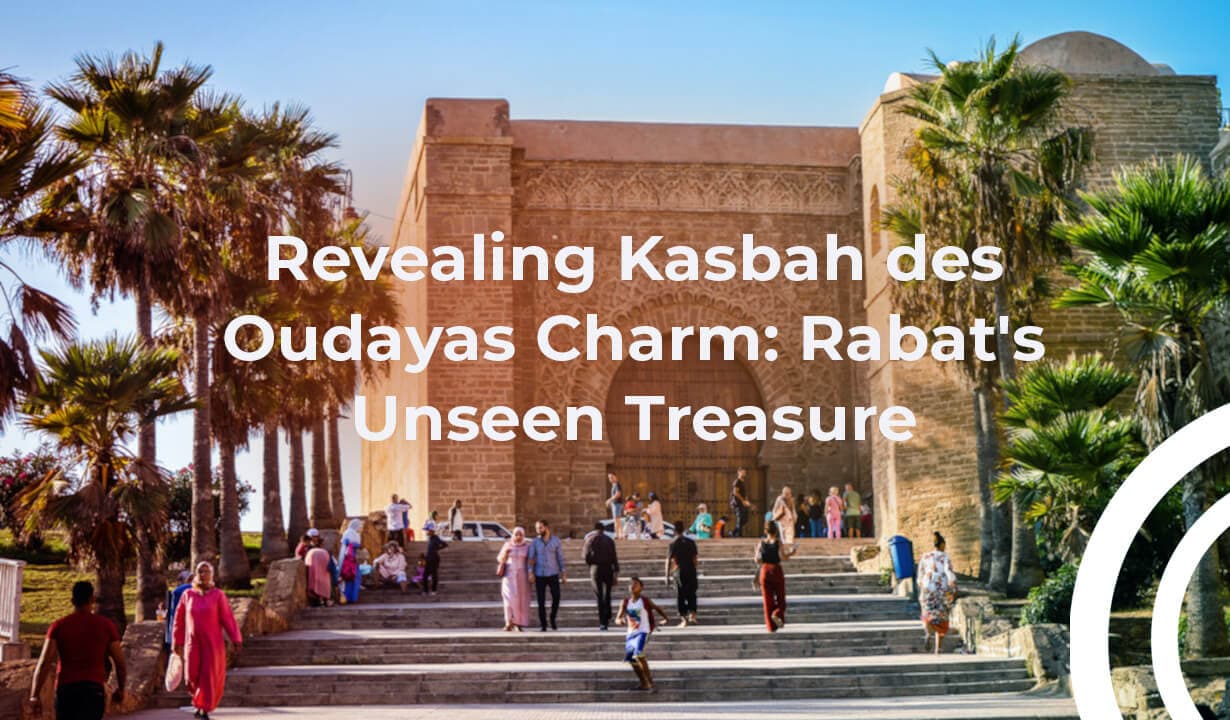
Nestled a brief quarter-hour promenade from the Rabat City Center exists the Kasbah des Oudayas at the Bou Regreg estuary, a veritable fortress of yore dating back to the twelfth century.
Boasting an imposing Almohade gateway, the Kasbah is a site of fascination, presenting visitors with an unparalleled loveliness that encompasses the Andalusian-style garden, a museum, a number of riyads, and several mosques.
The Andalusian influence is all-pervading, evident in the homogenously plastered walls, the dominant blue-hued doors, and the wrought-iron fenestrations...With UNESCO listing the Kasbah of the Oudayas on the World Heritage register, the site has become a veritable sanctuary of serenity and creative inspiration for many Moroccans and worldly artists.
Seduced by the beauty of the place and its calming ambiance, visitors are compelled to succumb to its enchantments. Undoubtedly, the most compelling aspect of the Kasbah is the renowned Moorish Café, which can be reached via the labyrinthine alleyways.
A place of unequivocal allure, the café is a must-visit, where one can revel in a refreshing mint tea and relish some toothsome almond delicacies.
The Kasbah remains an unequivocally recommended venue for unwinding and leisure, presenting an awe-inspiring vista of the Bou Regreg estuary and the ceaseless ebb and flow of rowing boats between the riverbanks.
History of Kasbah des Oudayas
The Udayas Kasbah holds a significant role in the early history of Rabat, dating back to the 12th century when it served as a strategic fortification for the Almohad dynasty against invading forces and pirate ships.
It was during the Alouite dynasty that the Kasbah flourished as Sultan Yacoub al Mansour hired the Oudayas tribe to defend the city and further fortified the structure, adding western ramparts and a luxurious palace for himself.
Despite his investment in the city, the Kasbah was eventually left somewhat abandoned after the sultan's death.
However, the walled city continued to be inhabited by different peoples, each leaving their unique mark on the Kasbah.
In the 17th century, Muslim immigrants fleeing from Catholic Spain sought refuge in the abandoned Kasbah and constructed the Pirates' Tower, leading all the way down to the river.
Today, the Kasbah des Udayas thrives as a city within a city and is home to around 2,000 of Rabat's citizens.
It boasts its own mosque, fountain, hammam, and even a communal bread oven, making it a bustling community on the Bou Regreg river.
Inside of the Oudaya Kasbah
The Oudaya Kasbah has a rich history, with various groups of people adding their unique touches to the architecture and culture of the area. The Almohad gate, called Bab Oudaia, is a spectacular entrance to the Kasbah, built in 1195 with carved arches and dressed stones.
The main street, Rue Jamaa, leads to the Plateforme du Sémaphore, with a cooperative for carpet weaving housed in a converted 18th-century warehouse in the Kasbah’s main square.
The oldest mosque in Rabat, known as the Old Mosque, is located in the Kasbah and features a minaret decorated with small arcades. From the platform on the ocean side of the semaphore station, visitors can enjoy panoramic views of Salé and the Bouregreg Estuary.
The Kasbah's architecture and gardens, which mimic those in Andalusia, show the influence of the returnees from Andalusia who played an important role in shaping the area.
The Kasbah Today
The Oudayas Kasbah in Rabat is a historic site that dates back to the 12th century. Initially built as a fortification to protect the city from pirate ships and invading forces, the Kasbah was later fortified and expanded by Sultan Yacoub al Mansour.
Despite being somewhat deserted after his death, different peoples continued to inhabit the walled city and add their personal touch to it.
Today, the Kasbah is a flourishing city within a city, home to around 2,000 of Rabat's citizens. It boasts a mosque, fountain, hammam, communal bread oven, and modern establishments such as hip cafes and shops.
Visitors can explore the Kasbah and discover its historical sites, including the 12th-century mosque and the Musée des Oudayas, which houses traditional Moroccan artwork, carpets, astronomical instruments, and ancient items like a 12th-century Koran. The Oudayas Garden, located on the banks of the Bou Regreg River, is also a must-visit spot in the Kasbah.
The Oudayas Kasbah perfectly combines ancient features with modern establishments and a friendly atmosphere, making it a must-visit destination in Morocco.
Conclusion
The Kasbah des Oudayas in Rabat is a true gem of Morocco. Its charming streets, stunning architecture, and rich history make it a must-visit destination for anyone traveling to the country.
Whether you're a history buff, a lover of culture, or simply looking for a beautiful place to explore, the Kasbah des Oudayas is sure to captivate you.